 Amaptik
 · why verified offload matters
Has this ever happened to you?
When we were building Amaptik, we didn’t think, hey, how many cool things can we add? How many more switches? It was, in fact, the opposite. Our mantra is and was: how can we help the overworked pro at the end of the day?
You copied the same footage twice.
Half the card went over last week. Tonight you copy all of it again, wait twice as long, and run out of space.
“Already copied: 27 of 67 files · July 2. New: 40 files.”
Never copy the same footage twice. Never buy a drive for footage you already have.
You babysat the progress bar.
Ten cards, one reader, and you sitting there swapping them at midnight.
“Press GO once. Then just swap cards. … Insert, walk away, swap, walk away.”
Don’t babysit the job. Pack up the gear.
Nobody knew it was done.
The producer kept asking “are we good?” You kept walking back to the screen to check.
“The verdict texts you. Or your client.”
Go home. It texts you the moment it’s done.
The card that got formatted too early.
Someone saw a green bar and reformatted the card. It wasn’t finished.
“SAFE TO FORMAT appears only when every file verified on every destination … No partial pass. No ‘probably.’”
No guessing at 1 a.m. Format when it says so, and not a minute before.
Four unlabeled cards, and a job started over.
Another department hands you four cards with no labels. Halfway through you lose track and start again.
“COPIED OCT 14 · 3:12 PM → SHUTTLE-02 · ALL 28 · CONFIRMED 13”
No starting over. Drop any card and you know where you stand.
“Do you still have the raw footage?”
Six months later the client calls. You’re sure you copied it. You can’t prove it.
“You didn’t just move the footage. You can prove you moved it intact.”
Answer the call in thirty seconds, with a PDF in hand.
The names were a mess.
Three cameras, all writing C0001.
“Hand your editor real names.”
No Monday-morning detective work.
The drive quit at 2 a.m.
“Drop a drive. If it’s wearing out, Amaptik tells you before you trust it with the day.”
Find out at the drop, not in the morning.
Who it's for.


For Filmmakers Your card, proven on every drive before you format it.
Amaptik · The shooter-DIT · 4:00 AM after wrap
Wrap was 45 minutes ago. You’ve been on your feet since five yesterday morning. Three cards of RAW sit on the desk, the producer has asked “are we backed up?” twice, and post wants the shuttle drive at call time.
You drop the first card in and set three drives: the shuttle, the transport RAID, a backup. Amaptik reads the card once and writes all three at the same time. The screen shows every drive’s speed, the file count climbing, and the time you’ll be finished. You tell the producer: done at 4:38.
Then you add her number to the text. Amaptik reads every copy back from its own drive and matches it, file by file, and only then says VERIFIED. When it does, the verdict goes to both phones at once: copied, verified, safe to format. She stops asking.
This is where you stop being the shooter who says “I think so.”
On every drive, the paperwork is already written: a PDF report production can read and file, an HTML version for anyone without the app, a plain-text receipt, and a standard MHL hash list post can check every file against. MD5 or SHA-256 when the delivery spec names one.
At the production office, the report ends in a signature block: RECEIVED — drive containing the files listed in this record, verified at handoff. The PA signs. You both keep a copy.
You don’t hand over a drive. You hand over proof.
Everything it does for filmmakers
A copy you didn’t verify isn’t a backup.
It’s a guess.
Copied once, written everywhere.
One read of the card, up to three drives, each checked on its own.
- One read
- One read of the card writes multiple verified copies at the same time.
- Three drives, one pass
- Up to three verified destinations in one pass
- Automation
- Press GO once. Every card that verifies 100% ejects itself, and the next one starts on its own.
- Flight Deck
- Every drive’s speed, Space Guardian™ before GO, and the time you’ll actually be done.
Proven, not assumed.
Nothing is called verified until it has been read back from the drive itself.
- Verify
- Every file is hashed, read back from the drive, and matched byte-for-byte.
- Safe to format
- One green ring. Safe to format means every file verified on every drive.
- No half files
- No file wears its real name until it’s proven, so a half-written file can never pass for a finished one.
- Card memory
- Amona Cortex™ remembers every card it’s seen, and tells you exactly what’s new.
Paperwork post can check.
The hashes and lists a delivery spec asks for, written to every drive.
- Delivery hashes
- xxHash64 on every run; MD5 or SHA-256 when a client or archive requires it, carried through the receipt and the report.
- Receipt and MHL
- A plain-text receipt travels with the footage, forever, plus an MHL if you switch it on.
- Sign-off
- A signature block for the drive handoff
The rest of the night.
The small things that save the last hour on set.
- Text when done
- When the run settles, the verdict lands on your phone — or your client’s.
- Unwrap
- Camcorder takes joined and rewrapped into single clips as you copy. Nothing re-encoded.
- Clone
- Turn RENAME and UNWRAP off for a true mirror: original names, original bytes, nothing touched.
- Media Passport
- ⌘I shows what’s inside any clip or photo: codec, camera, and the rest of its metadata.
“Verified means verified.”
— Marc Smiler, founder
Try it on your own footage.
Download, open, insert a card. The trial starts when you do — six cards, no card details, nothing switched off.
Get AmaptikRequires macOS 14 or later on Apple silicon. Full system requirements →
For Wedding Fourteen cards, one tired night, zero guessing.
Amaptik · The wedding filmmaker · 12:40 AM, home from the reception
You pull into the driveway after a ten-hour day. The car is full of stands, cases and a wallet of cards from three cameras, a drone, your multitrack audio recorder, and of course individual lavs from the groom, the officiant and the bride. Every camera card starts at 0001.MOV.
You carry the laptop and the card wallet in first. Card 1 goes in the reader, three drives go on the desk: the client’s, your archive, a backup. Press GO, and go back out to the car. Amaptik reads the card once and writes all three while you unload.
A-cam, B-cam and the drone each called their first clip 0001.MOV. Every one lands under its own name, and nothing replaces anything. The names already carry the client, the project and the time the camera shot it, so Saturday will still say Saturday when you edit on Tuesday.
Each trip back in, the next card. Somewhere around the lighting cases, you’re not sure any more. Was that card 3? Did card 5 ever go in?
Put the card in and ask.
Card 3 comes back already known: copied tonight, to which drives, at what time. Card Recall remembers every card it has copied on this Mac, so a card you’ve done is recognized, not copied twice. Card 5 comes up with nothing on record. New. That’s the one you missed, and you’ve caught it before you ever format it.
Before you trust a new card, hover down the clips and press Space to open one full size, the way you would in Finder. The vows are there. B-cam rolled.
The Mac stays awake while it works. Every file is read back from every drive and matched before Amaptik says VERIFIED, and then, in plain words, SAFE TO FORMAT. The text reaches your phone as you’re carrying in the last case.
Car empty. Cards done. Bed.
Monday, the couple’s drive goes out. In its Reports folder: a proof sheet of the whole day, a frame from every clip, and a report that ends in a signature line saying the drive holds every file listed, verified at handoff.
They sign for their wedding.
You never get the “do you still have the raw footage?” call.
Everything it does for wedding filmmakers
Nothing gets overwritten.
Ever.
Every card, every camera.
Three cameras, a drone and the audio, all starting at 0001. Nothing collides, and nothing gets missed.
- Same names, no clash
- A-cam writes 0001.MOV. B-cam writes 0001.MOV. The drone writes 0001.MOV. Amaptik doesn’t trust filenames to tell the story. It compares contents.
- Card memory
- Amona Cortex™ remembers every card it’s seen, and tells you exactly what’s new.
- Card labels
- Mark each card by hand as it goes in: Camera, Audio or Drone, and a role — Lav A, Groom, Bride, Clergy, Vows, Toasts, B Cam, Wide.
- Multitrack audio
- Amaptik reads the embedded metadata and recorder folder structure and recognizes when tracks belong together.
Unload the car while it works.
Press GO once and walk away. The cards keep moving and your phone tells you when they’re safe.
- Automation
- Press GO once. Every card that verifies 100% ejects itself, and the next one starts on its own.
- Three drives, one pass
- Up to three verified destinations in one pass
- Flight Deck
- Every drive’s speed, Space Guardian™ before GO, and the time you’ll actually be done.
- Text when done
- When the run settles, the verdict lands on your phone — or your client’s.
Named and in order.
The names and dates come from the cameras, so Saturday still says Saturday.
- Real names
- See the real filename, live, before a single file is touched.
- The camera’s clock
- Every copy’s Date Created is the moment you shot it, so Finder sorts the day in order.
- Unwrap
- Camcorder takes joined and rewrapped into single clips as you copy. Nothing re-encoded.
- Read-only cards
- Amaptik never writes to, erases, or formats a card.
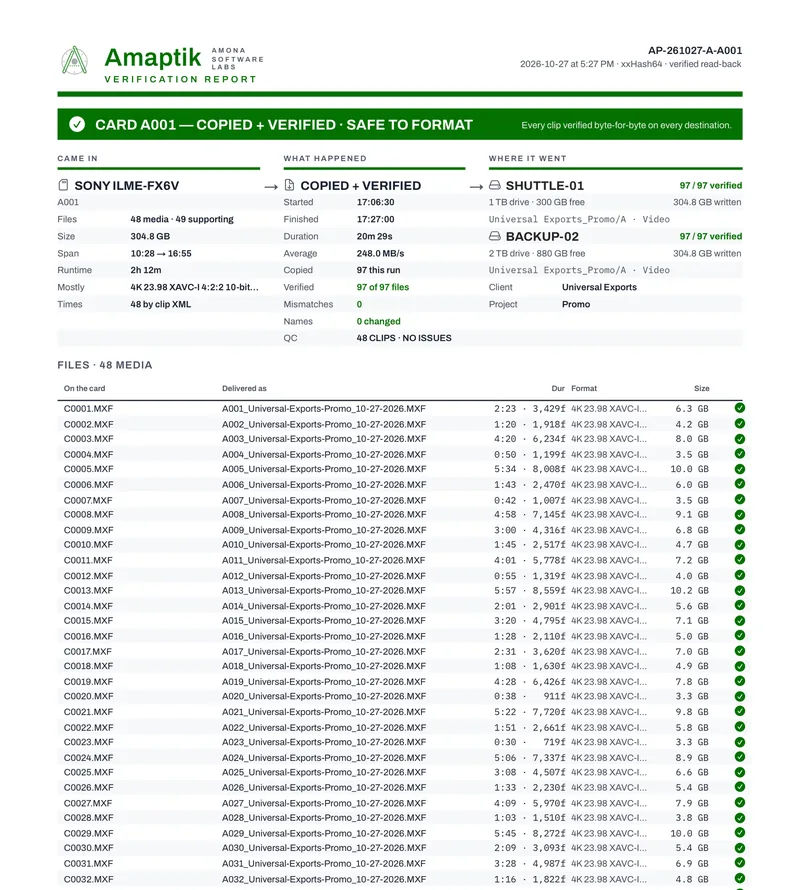
Proof for the couple.
Hand over a drive that says what’s on it, and get it signed for.
- Verify
- Every file is hashed, read back from the drive, and matched byte-for-byte.
- Safe to format
- One green ring. Safe to format means every file verified on every drive.
- Reports
- PDF and HTML reports, Digital Proof Sheet™
- Sign-off
- A signature block for the drive handoff
“The camera’s clock, not the Mac’s.”
— Marc Smiler, founder
Try it on your own footage.
Download, open, insert a card. The trial starts when you do — six cards, no card details, nothing switched off.
Get AmaptikRequires macOS 14 or later on Apple silicon. Full system requirements →
For Photographers Every frame on one sheet. Every frame proven.
Amaptik · The commercial photographer · 2:00 AM before a 6:00 AM delivery
You shot 4,000 RAW files for an apparel client today. The creative director wants a link by six, and you’re reading folder names with blurred vision.
Two bodies, two cards. Both counters rolled past 9999 somewhere around the second look, so both cards are full of the same filenames. Amaptik compares what’s inside the files, not just their names, so nothing overwrites anything.
Each RAW and its JPEG are one shot: one number, one name, copied together, with their sidecars traveling alongside. Every still is read back from each drive and matched. Thousands of small files, each one proven, not just counted.
And then there’s the sheet.
With the Digital Proof Sheet on, each card ends with a contact sheet of every frame, fitted, never cropped, each RAW+JPEG pair as a single tile, filed on every drive. You attach it to the delivery email. The creative director sees the whole shoot at a glance, and you have proof that every frame of it arrived.
Then, and only then, you open Lightroom and start culling.
Everything it does for photographers
Open Lightroom and start working.
Not waiting.
Every frame, accounted for.
A photo card is a media card. Every file on it arrives, stays with its partners, and is proven on every drive.
- RAW + JPEG
- RAW and JPEG can arrive together and stay together, or be separated according to your workflow.
- Sidecars
- Sidecars stay with the files they belong to.
- Every frame proven
- Thousands of small files are verified individually.
- Counter rollover
- Rollover collisions are caught by comparing contents, not just filenames.
Named, dated, sorted.
Names and dates are set once, from the camera’s own data, so the catalog opens in order.
- Real names
- Client, project, date, camera and counter in every filename, built from blocks you drag into place. See the name before a single file is touched.
- The camera’s clock
- Capture time to the sub-second, in the zone the camera was set to. Every copy’s Date Created is the moment you shot it, so Finder sorts the day in order.
- Card labels
- Mark a card Photo and give it a role by hand: Stills, BTS, Model, Landscape, Bride, Groom, Family.
- Media Passport
- EXIF can be inspected before you commit — camera, lens, ISO, shutter, capture time.
A big day, hands-free.
Four cards, three drives, one GO. Amaptik keeps track of every card so you don’t have to.
- Automation
- Press GO once. Every card that verifies 100% ejects itself, and the next one starts on its own.
- Three drives, one pass
- Up to three verified destinations in one pass
- Card memory
- Insert that card an hour later or six months later and Amaptik recognizes it.
- Clone
- Turn RENAME and UNWRAP off for a true mirror: original names, original bytes, nothing touched.
Proof for the client.
What you hand over says what arrived, frame by frame, and who signed for it.
- Digital Proof Sheet
- A contact sheet of every frame on the card, fitted, never cropped, each RAW+JPEG pair as one tile, filed on every drive.
- Reports and sign-off
- PDF and HTML reports, with a signature block for the drive handoff.
- Text when done
- The verdict, texted to your phone — or your client’s
- Read-only cards
- Amaptik never writes to, erases, or formats a card.
“Source media is immutable. Cards are read-only, always.”
— Marc Smiler, founder
Try it on your own footage.
Download, open, insert a card. The trial starts when you do — six cards, no card details, nothing switched off.
Get AmaptikRequires macOS 14 or later on Apple silicon. Full system requirements →
For Sound Eight files. One take. Amaptik can tell.
Amaptik · The production sound mixer · midnight in the hotel room
Fourteen hours of dialogue on an eight-track recorder: the boom, the lavs, a mix, a safety. Dozens of takes, eight files each, and an editor who needs every one of them in the morning.
To the Mac, those are eight unrelated WAV files. To your editor, they’re one recording. Amaptik groups each take from the recorder’s own evidence (the take folder, the broadcast-WAV start time and time reference, the matching length) and lands it as one take, the tracks numbered together in the order they were recorded. The safety stays the safety.
While the card runs, the screen names your recorder from the file itself, ZOOM F8n Pro, with the sample rate, bit depth and channel count. Its clock becomes every copy’s Date Created, so the day sorts in the order you rolled.
Before you format the card, you look at the proof sheet.
Every take is drawn there, full width, from the verified copy: room tone as a quiet band, dialogue as shape, and a take that never recorded as a flat line. You see it tonight, not when the editor calls at ten.
Two drives, one pass. The proof sheet, the receipt and the hash list travel on each, and the verdict texts the editor as well as you: every file copied, verified, and safe to format.
Sound arrives the way it was recorded.
Your editor opens a session, not a puzzle.
Everything it does for sound
Verified isn’t a green bar.
It’s proof.
The take stays whole.
Eight files from one take arrive as one recording, the way your editor needs them.
- One take
- Amaptik reads the embedded metadata and recorder folder structure and recognizes when tracks belong together. It groups them and keeps the take whole.
- Safety tracks
- It understands safety tracks as safety tracks, rather than treating them as redundant files to discard.
- The recorder’s clock
- Its clock becomes every copy’s Date Created, so the day sorts in the order you rolled.
- Your recorder, named
- The screen names your recorder from the file itself, with the sample rate, bit depth and channel count.
See it before you format.
Know what you’ve got tonight, not when the editor calls.
- Waveforms
- Every take’s waveform is drawn on the proof sheet, full width, from the verified copy.
- Card labels
- Mark a card Audio or Multitrack and give it a role by hand: Lav A, Boom, Groom, Clergy, Mix, ISO, Safety, Room Tone.
- Media Passport
- ⌘I shows what’s inside any clip or photo: codec, camera, and the rest of its metadata.
- Read-only cards
- Amaptik never writes to, erases, or formats a card.
Proven on every drive.
Each file is read back from the drive itself and matched.
- Three drives, one pass
- Up to three verified destinations in one pass
- Verify
- Every file is hashed, read back from the drive, and matched byte-for-byte.
- Safe to format
- One green ring. Safe to format means every file verified on every drive.
- Delivery hashes
- xxHash64 on every run; MD5 or SHA-256 when a client or archive requires it, carried through the receipt and the report.
Out the door.
The paperwork travels with the sound, and the verdict reaches the editor.
- Receipt and MHL
- A plain-text receipt and MHL hash list travel with the footage, forever.
- Text when done
- When the run settles, the verdict lands on your phone — or your client’s.
- Automation
- Press GO once. Every card that verifies 100% ejects itself, and the next one starts on its own.
- Clone
- Turn RENAME and UNWRAP off for a true mirror: original names, original bytes, nothing touched.
“A flat line tells an engineer the mic was unplugged, like a black picon tells a DP the lens cap was on.”
— Marc Smiler, founder
Try it on your own footage.
Download, open, insert a card. The trial starts when you do — six cards, no card details, nothing switched off.
Get AmaptikRequires macOS 14 or later on Apple silicon. Full system requirements →
Try it on your own footage.
Download, open, insert a card. The trial starts when you do — six cards, no card details, nothing switched off.
Requires macOS 14 or later on Apple silicon.